Why Leadership Failure Is Not a Character Issue
Rich Baron • February 6, 2026
Why the Real Breakdown Happens Between Intent and Impact
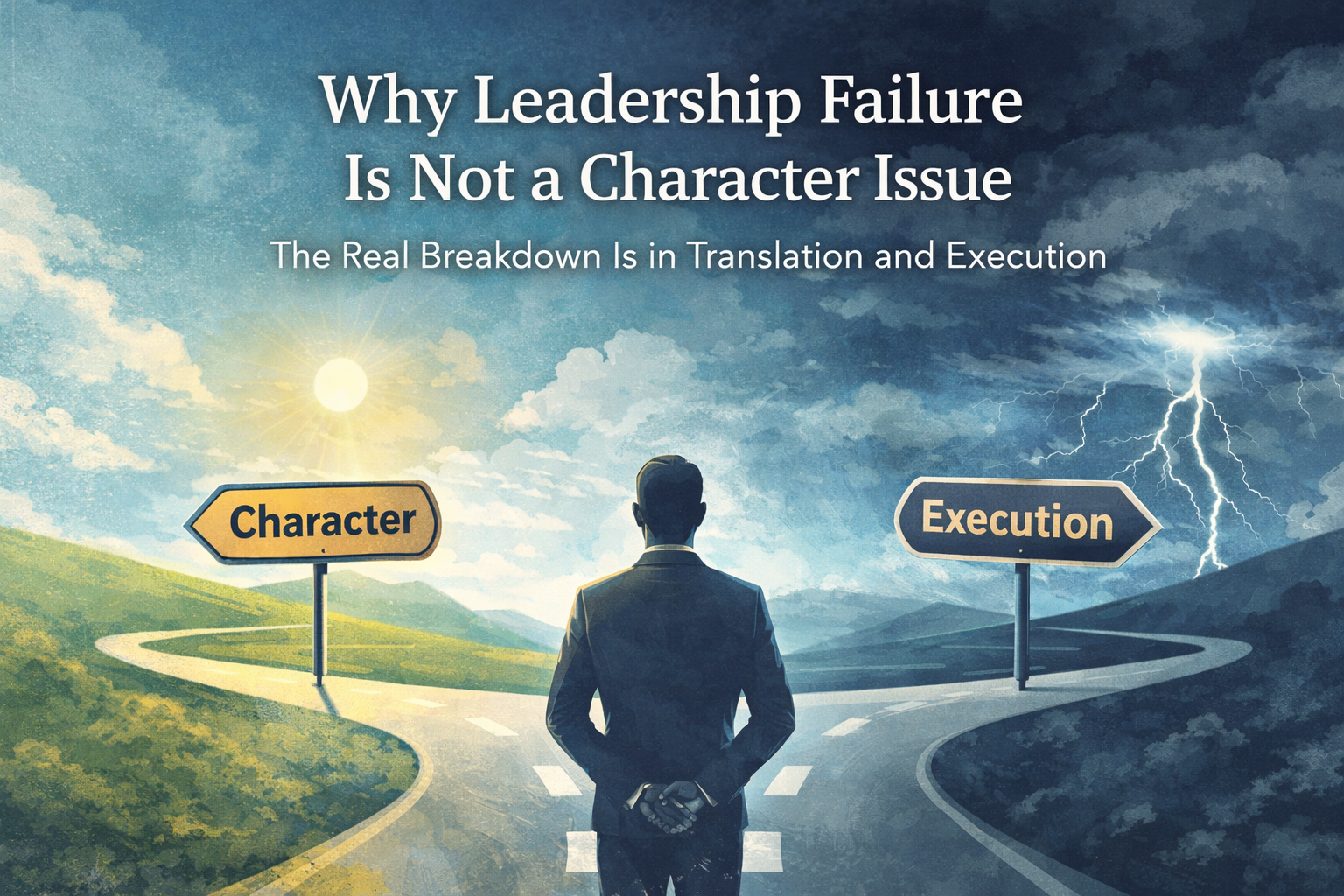
This may go completely against the grain of much of today’s leadership and coaching dialogue, but the truth is this:
Most leadership failures are not character failures.
They are failures of translation and execution.
For years, leadership development has emphasized values, integrity, authenticity, and purpose—and rightly so. Character matters. Leadership without character is dangerous. But here’s the uncomfortable reality many coaches and organizations quietly experience:
The majority of leaders who struggle are not unethical, unprincipled, or immature.
They are well-intentioned, values-driven, and genuinely committed to doing the right thing.
And yet… results still fall short.
So the question becomes: why?
The Problem with Assuming Leadership Fails at Character
When leadership outcomes disappoint, the default explanation is often some variation of:
- “They lack self-awareness.”
- “They need to work on empathy.”
- “They don’t have the right values.”
- “They’re not emotionally intelligent enough.”
Sometimes that’s true. But far more often, it isn’t.
This assumption creates two serious problems:
- It misdiagnoses the issue.
- It places unnecessary moral weight on what is often a structural or cognitive problem.
Most leaders who fail are not failing because they don’t care.
They are failing because what they care about isn’t showing up clearly, consistently, or effectively in action.
Character Creates Capacity — Not Impact
In the John Mattone Global (JMG) model, we make a critical distinction:
"Character creates capacity. Impact is created through translation and execution."
Character answers questions like:
- Can this leader be trusted?
- Are they grounded in values?
- Do they have the maturity to handle power responsibly?
These are Inner Core questions—and they matter deeply.
But character alone does not answer:
- How quickly does this leader make decisions?
- How do they process complexity and uncertainty?
- How do their values show up under pressure?
- How are their decisions experienced by others?
- Do their behaviors consistently reinforce their intent?
That’s where leadership actually succeeds or fails.
Where Leadership Really Breaks Down: Translation
Translation is the moment where:
- Values become decisions
- Intent becomes communication
- Maturity becomes behavior
- Purpose becomes action
This is where many capable leaders struggle.
- A leader may value transparency—but communicate too late.
- They may value empowerment—but over-control decisions.
- They may value fairness—but avoid necessary conflict.
- They may value excellence—but overwhelm the system.
None of these are character flaws.
They are translation failures—breakdowns in how inner intent moves into real-time thinking and decision-making.
Execution Is Where Leadership Becomes Real
Execution is where leadership is felt.
This is where:
- Trust is either reinforced or eroded
- Culture becomes visible
- Strategy becomes lived experience
- Leadership becomes real for others
A leader can be mature, thoughtful, and principled—and still:
- Send mixed signals
- Move at the wrong pace
- Be unclear or inconsistent
- Undermine trust unintentionally
When this happens, people don’t experience the leader’s values—they experience their behavior.
And behavior, not intent, shapes outcomes.
Why This Reframe Matters for Coaches and Organizations
Reframing leadership failure as a translation and execution issue rather than a character issue does something powerful:
- It removes shame from the development process
- It avoids moralizing performance challenges
- It protects the importance of character
- It makes leadership development practical and actionable
Instead of telling leaders:
“You need to be better.”
We can say:
“We need to improve how what matters to you shows up in decisions and behavior.”
That’s a conversation leaders can engage with—and grow from.
The Integrated View: Why JMG Measures the Whole Leader
This is why John Mattone Global does not rely on a single lens.
- Inner Core measures who the leader is (character, values, maturity)
- Translation explains how the leader thinks, decides, and moves into action
- Outer Core reveals how leadership is actually experienced by others
Leadership doesn’t fail because leaders lack character.
It fails because character is not consistently translated into effective execution.
When those three layers align, leadership becomes not just well-intentioned—but impactful.
A Final Thought
Strong leadership is not about choosing between character and behavior. It’s about ensuring that who you are is clearly reflected in how you lead.
And that work—translation and execution—is where leadership development truly lives.
If you’re serious about improving your leadership impact, stop guessing where to focus.
John Mattone Global helps leaders translate who they are into how they lead—where results are actually created.
Reach out to us here: https://johnmattone.com/contact/
About the Author
Rich Baron is the Chief Operating Officer and Director of Global Coaching Projects at John Mattone Global (JMG) and a Master Certified Intelligent Leadership® Executive Coach. He partners with C-level leaders and high-potential executives around the world to strengthen trust, elevate culture, and drive sustainable transformation.
Rich leads large-scale coaching and cultural initiatives across multiple regions and industries and serves as a strategic bridge between executive teams, HR, and global coaching networks. He is also the co-host of the Mainline Executive Coaching ACT podcast, recognized as one of the top executive coaching podcasts globally, where he explores the real-world challenges and opportunities facing today’s leaders.
Through his work, Rich is dedicated to CHANGING THE WORLD One Leader, One Organization at a Time® by helping leaders move beyond performance and build the inner architecture required to become world-class executives.

Explore how success, power, and unchecked ego can turn visionary leadership into organizational risk—and why self-awareness and humility matter most.

Executive coaching during acquisitions strengthens leadership, trust, and culture when organizations face their greatest challenges.