Beyond Accreditation: What Real Executive Coaching Requires Today
Rich Baron • April 6, 2026
Elevating Coaching to Measurable Executive Impact
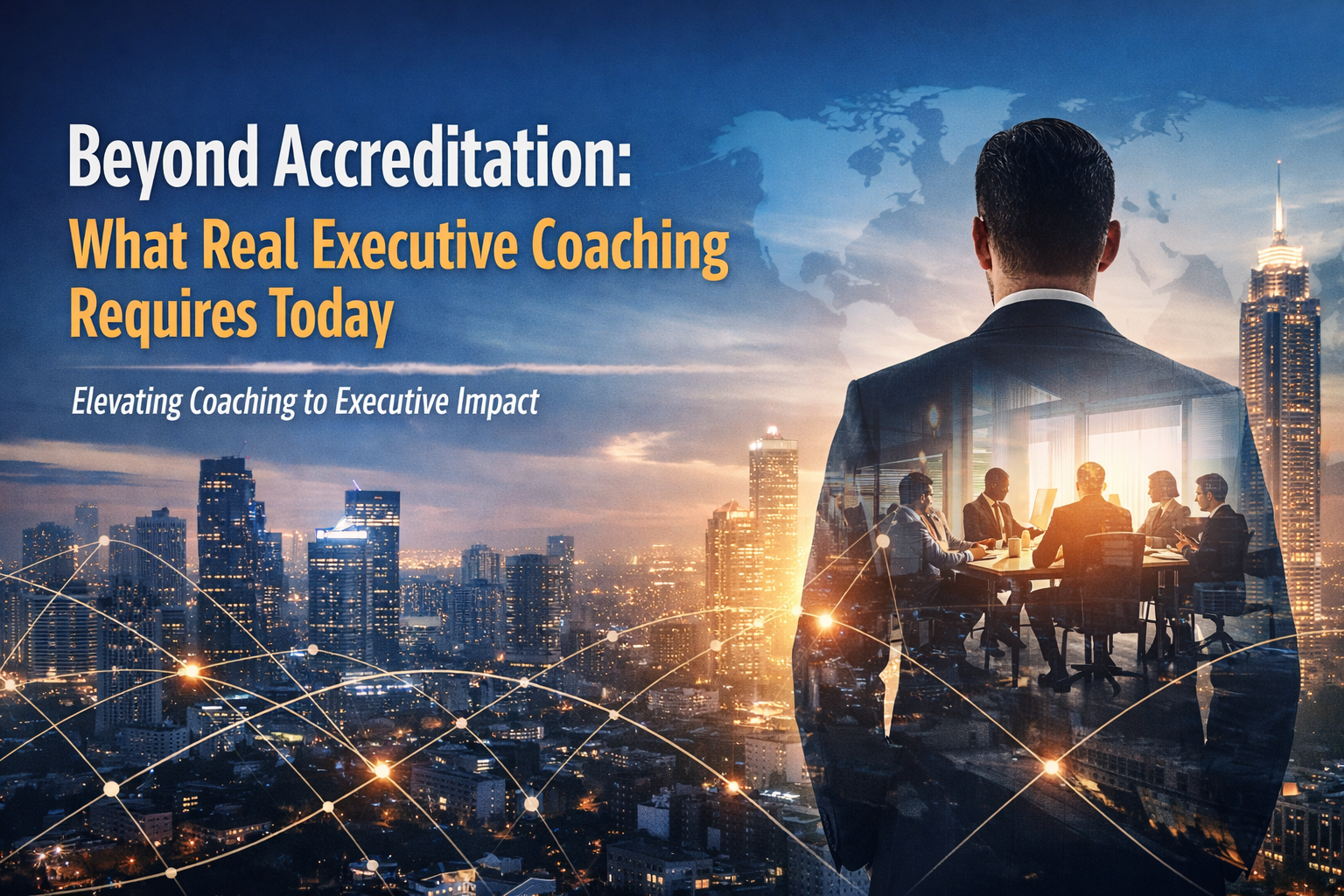
The coaching profession has matured dramatically over the past two decades.
Accreditation bodies — particularly the International Coaching Federation (ICF) — have played a critical role in elevating standards, ethics, and professional credibility worldwide. The rigor, structure, and discipline introduced through credentialing have strengthened the foundation of our industry.
That foundation matters.
But as executive coaching enters its next phase, we must be willing to say something that may feel uncomfortable:
Accreditation is not the same as executive impact.
And in today’s enterprise environment, that distinction matters more than ever.
The Credentialing Conversation
Over the past several years, I have interviewed hundreds of coaches across the globe — many of them ICF-certified at various levels.
What I have consistently found is this:
Many are exceptionally trained in the coaching process.
Many demonstrate strong listening skills, powerful questioning, and ethical discipline.
Many are deeply committed to human development.
Yet many of those I interviewed lack substantial one-on-one executive leadership coaching experience in high-pressure, high-accountability business environments. This is not a criticism of the individuals, but rather an observation about how the industry has developed.
ICF accreditation builds coaching craft.
It does not automatically build executive leadership expertise.
Those are different domains.
Executive leadership coaching at the highest level requires fluency in board governance, investor pressure, succession risk, executive team conflict, enterprise transformation cycles, and culture recalibration. These are not academic case studies. They are lived, high-consequence realities where decisions impact thousands of employees and millions — sometimes billions — in enterprise value.
The gap is not about talent.
It is about exposure.
The Credibility Challenge Facing the Profession
As the coaching industry has grown, it has also encountered a more complex challenge — one that cannot be ignored.
The profession remains largely self-regulated, which has created both opportunity and risk.
On one hand, accessibility has allowed coaching to expand globally. On the other, it has lowered the barrier to entry to a point where virtually anyone can present themselves as a coach — regardless of training, experience, or ethical grounding.
This has led to what some have begun to describe as a “credibility gap.”
Inconsistent training standards, the proliferation of low-quality certification programs, and the rise of transactional coaching platforms have contributed to a dilution of trust across parts of the market.
In some cases, inexperienced practitioners have taken on work far beyond their capability — without the appropriate background or safeguards in place.
The result is not just confusion in the marketplace — It is growing skepticism.
Leaders and organizations are becoming more discerning — not because they question the value of coaching, but because they are seeking assurance that the coach they engage can operate at the level required.
This is not a failure of the profession.
It is a signal—a signal that standards must continue to evolve.
That accreditation must be complemented by real-world experience. And that credibility must be earned through demonstrated impact — not simply declared through credentials.
Organizations like the ICF play a critical role in maintaining ethical standards and professional rigor. When those standards are unclear or inconsistently applied, trust erodes — and trust is the foundation of this profession.
But as the industry expands, responsibility does not sit with governing bodies alone.
It sits with all of us.
As the coaching industry continues to evolve, I’ve also found myself reflecting on my own role in helping elevate and protect the profession. I am currently preparing to sit for the ICF PCC credential — something that, for many years, was not on my radar. However, the longer I am in this profession, and the more I see both its potential and its challenges, the clearer it has become that the responsibility to elevate and protect the profession is more important than ever.
The Enterprise Has Evolved
As Chief Operating Officer of John Mattone Global and Director of Global Coaching Projects, I have the opportunity to work closely with large-scale organizations around the world. In that role, I see firsthand what enterprise clients are looking for when matching coaches with executives, senior leaders, and high-potential talent being developed for those roles.
Prior to 2024 — and even into early 2025 — credentials were among the primary indicators organizations relied on when evaluating coaches. That is now shifting. While accreditation remains important, enterprise clients are placing greater emphasis on real executive experience, contextual business acumen, and measurable leadership impact.
What is clear is this, organizations today are not simply looking for reflective space.
They are investing in:
• Behavior change tied directly to performance
• Leadership maturity growth across systems
• Cultural stabilization during volatility
• Strategic alignment at the executive team level
• Measurable return on investment
In large-scale global leadership engagements, coaching now sits inside transformation mandates — not outside them.
It operates alongside succession planning, M&A integration, digital transformation, restructuring, and enterprise-wide culture initiatives. Coaching is no longer a developmental “add-on.” It is embedded inside strategic execution.
In that context, process mastery alone is insufficient.
The coach must understand how leadership decisions ripple through capital markets, employee engagement, stakeholder confidence, and long-term enterprise sustainability.
Reflection remains essential.
But reflection without contextual business grounding increasingly limits impact.
What Real Executive Coaching Requires
Executive coaching today requires integration across multiple dimensions:
1. Deep Business Acumen
Understanding strategy, operational complexity, financial accountability, governance structures, and enterprise systems.
2. Experience with Senior Leadership Dynamics
C-suite relationships are not theoretical exercises. They involve power, ego, political capital, board visibility, and reputational risk. Coaches must know how to navigate these dynamics without destabilizing them.
3. Performance Architecture
Executives are not compensated for insight alone. They are accountable for enterprise results — revenue growth, culture health, succession readiness, innovation capacity, and transformation execution.
Coaching that does not tie directly to measurable leadership behavior shifts and organizational performance will increasingly be sidelined.
4. Systems-Level Thinking
Leadership behavior does not operate in isolation. It shapes culture, influences talent pipelines, and impacts enterprise resilience. Coaches must think beyond the individual and into the system.
5. Coaching Craft and Ethical Discipline
This is where accreditation shines — and why it remains essential. Ethical grounding, presence, listening, and non-directive inquiry are foundational.
But craft alone is insufficient.
Integration is the differentiator.
Honoring ICF — Without Confusing Scope
Let me be clear: ICF is a phenomenal accreditation body.
It has elevated professionalism in our industry. It has created global standards. It has protected the integrity of coaching practice.
I have tremendous respect for the organization and its leadership, including CEO Magda Mook, with whom I’ve had the opportunity to engage on multiple occasions and host as a guest on a podcast I co-host.
But accreditation is a benchmark — not a guarantee of executive leadership impact.
At the same time, when executive-level business acumen is coupled with ICF accreditation, it becomes a powerful combination that is difficult to replicate. The discipline of learning the nuances of coaching, combined with real-world enterprise leadership experience, creates a level of depth, credibility, and impact that is hard to beat.
In medicine, a degree is necessary. Experience in the operating room is transformational.
Executive coaching is no different.
Credentialing establishes competence.
Experience builds credibility.
Integration creates impact.
The Industry Is Not Saturated — It Is Transitioning
There is growing conversation about whether the coaching market is “crowded.”
I see it differently.
The industry is not saturated with too many coaches, it is transitioning from a credential-driven market to an impact-driven one.
Enterprise buyers are becoming more sophisticated. They are asking more precise — and more demanding — questions:
- How does this coaching tie directly to strategic outcomes?
- What measurable leadership shifts can we expect?
- How does this integrate into broader transformation initiatives?
- What real executive experience does the coach bring into the engagement?
Increasingly, organizations are not choosing between accreditation or experience — they are seeking both.
The combination of strong coaching craft, grounded in accreditation, and real-world executive leadership experience is emerging as the new standard.
Those who bring only one dimension will find themselves limited.
Those who integrate both will define the future of the profession.
The coaches who will thrive in the next decade will:
- Honor the developmental roots of coaching
- Build substantial executive-level experience
- Develop proprietary intellectual property and frameworks
- Integrate data and measurable outcomes
- Operate as strategic enterprise partners — not just reflective practitioners
The future does not belong to the most certified.
It belongs to the most integrated.
At John Mattone Global, we have seen this evolution firsthand — and we recognize both the value of accreditation and the absolute need for real-world enterprise experience.
Our Intelligent Leadership® Coaching Certification is widely recognized as one of the premier executive coaching development programs globally. Founded by John Mattone — consistently ranked as the world’s #1 coaching authority by GlobalGurus.org — the program is ICF-accredited and built on a comprehensive leadership transformation methodology that integrates both the inner and outer dimensions of leadership.
With over 800 certified coaches across more than 55 countries, and a methodology applied within Fortune 500 organizations, the program is designed not just to teach coaching, but to develop coaches who can drive measurable leadership, cultural, and organizational impact.
In addition, our certification pathway offers one of the most comprehensive ICF Continuing Coach Education (CCE) structures globally.
This is not about promotion — it is about illustration.
When coaching craft is combined with real-world executive leadership experience, supported by structured methodology, measurable frameworks, and continuous development, the result is a level of coaching capability that defines the future of the profession.
A Call to Elevate, Not Divide
This is not a dismissal of certification, It is a call to elevate the standard.
Accreditation establishes baseline competence while executive impact requires depth, integration, and lived leadership context.
The coaching profession has done extraordinary work building its foundation.
Now we must build its next layer.
Beyond accreditation.
Toward measurable executive transformation.
About the Author
Rich Baron is the Chief Operating Officer and Director of Global Coaching Projects at John Mattone Global (JMG) and a Master Certified Intelligent Leadership® Executive Coach. He partners with C-level leaders and high-potential executives around the world to strengthen trust, elevate culture, and drive sustainable transformation.
Rich leads large-scale coaching and cultural initiatives across multiple regions and industries, and serves as a strategic bridge between executive teams, HR, and global coaching networks. He is also the co-host of the Mainline Executive Coaching ACT podcast, recognized as one of the top executive coaching podcasts globally, where he explores the real-world challenges and opportunities facing today’s leaders.
Through his work, Rich is dedicated to CHANGING THE WORLD One Leader, One Organization at a Time® by helping leaders move beyond performance and build the inner architecture required to become world-class executives.

Executive coaching during acquisitions strengthens leadership, trust, and culture when organizations face their greatest challenges.

Limiting beliefs feel like facts—but they’re not. Learn how to recognize, challenge, and replace them to unlock growth and leadership potential.