Why Great Leaders Must Know the System
Rich Baron • February 9, 2026
Process Fluency Is the Architecture of Durable Leadership
Throughout my career—as a senior operational leader and now as Chief Operating Officer and Director of Global Coaching at John Mattone Global—I have held a conviction that has guided nearly every leadership decision I’ve made:
If you are accountable for results, you are accountable for understanding the system that produces them.
Not at a surface level.
Not through dashboards or delegation alone.
But deeply enough to make principled decisions, recognize excellence, and build an organization capable of sustaining performance beyond any single leader.
This belief was shaped through years of leading complex operations—navigating regulatory environments, serving demanding customers, and building leadership systems designed to scale globally. Over time, one truth became clear: leadership durability is never accidental. It is designed.
SQDIP: A Leadership Decision Framework
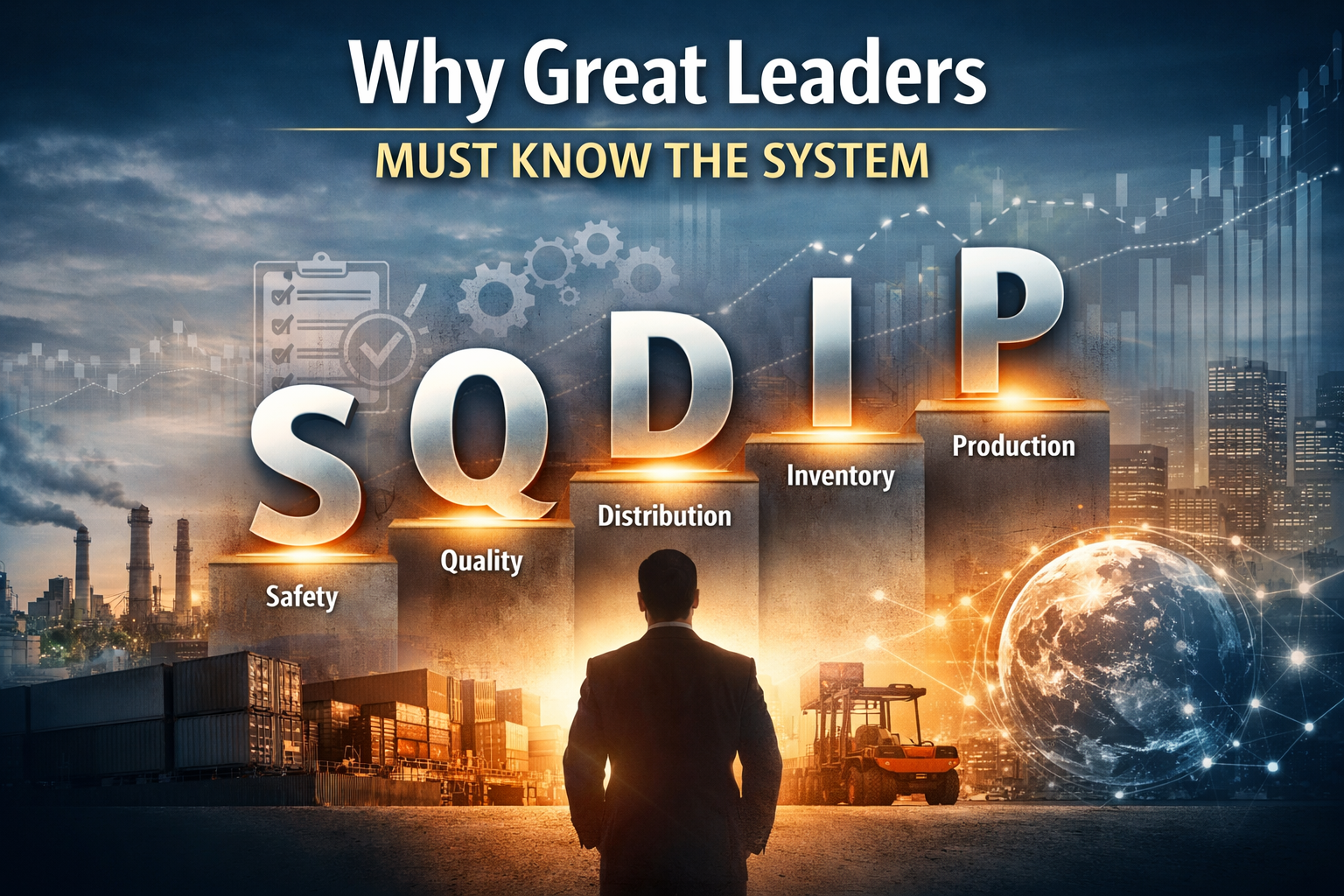
Early in my operational career, I learned a disciplined production process called SQDIP (pronounced “SKEW-dip”) that anchored decision-making when urgency, trade-offs, and pressure converged. I made SQDIP part of the fabric of the facility and later applied it as a foundational decision framework in other organizations.
SQDIP is:
- Safety
- Quality
- Distribution
- Inventory
- Production
This order is intentional—and non-negotiable.
SQDIP was never a slogan. It was a decision framework. When leaders are forced to choose, this sequence reveals whether they are leading with responsibility or reacting to pressure.
Safety: Leadership’s First Obligation - Safety is not a compliance requirement; it is a moral obligation. Leaders who compromise safety—physical or psychological—undermine trust at its foundation. No culture recovers fully from the message that people are expendable in the pursuit of results.
Quality: The Right to Be Trusted - Quality reflects leadership integrity. When quality becomes negotiable, credibility erodes quietly but decisively. Leaders do not lose trust because they demand excellence; they lose it when excellence bends under pressure.
Distribution: Confronting Reality - Distribution forces leaders to face reality beyond internal metrics. Operations exist to serve customers, patients, and stakeholders. Internal efficiency that fails externally is not success—it is misalignment.
Inventory: Discipline Revealed - Inventory exposes leadership foresight. Excess or shortage reveals planning failures long before performance indicators do. Inventory is never neutral; it tells the truth about leadership discipline.
Production Comes Last—By Design - Production matters. But speed without discipline creates fragile systems. Leaders who prioritize production over fundamentals often achieve short-term gains at the expense of trust, resilience, and people.
SQDIP and Short Interval Control: Different Cadences, Different Leadership Work
In many operational environments, leaders rely on Short Interval Control (SIC)—a well-established Lean management methodology designed to monitor production metrics frequently, often hourly or per shift. SIC enables front-line teams to identify issues quickly, analyze root causes, and implement immediate corrective actions. When executed well, it increases efficiency, reduces downtime, and improves quality through rapid, data-driven decisions supported by visual management tools.
SIC plays an important role. It creates operational discipline at the front line.
But SQDIP serves a different leadership purpose.
While SIC operates at a short cadence to manage performance within the day, SQDIP operates at a daily systems level, allowing leaders to understand how the entire operation is functioning as an integrated whole.
SQDIP is not a production control mechanism.
It is a leadership accountability system.
By reviewing Safety, Quality, Distribution, Inventory, and Production daily—and in that order—SQDIP enables senior leaders and individual managers to truly understand their processes, not just their numbers. It forces leaders at every level to learn how their function impacts others, where risk is emerging, and where accountability truly resides.
This daily systems view does three critical things:
- It requires managers to know their processes, not manage by exception
- It makes leaders acutely aware of what is happening across the facility, not just within their silo
- It creates real-world cross-functional teams, because problems are examined through a shared system lens rather than isolated metrics
Over time, SQDIP destroys organizational silos. It replaces functional defensiveness with enterprise ownership. Leaders stop optimizing locally and start leading systemically.
In this way, SIC and SQDIP are not competitors.
They are complementary.
SIC strengthens execution at the front line.
SQDIP strengthens leadership understanding, accountability, and enterprise alignment.
And it is that alignment—far more than any single metric—that creates durable performance and lasting leadership impact.
Knowing the System Does Not Mean Being the Best Operator
One of the most important leadership lessons I learned—and one reinforced repeatedly by experience—is this:
Understanding the system does not require being the best operator within it.
I never believed my role was to out-perform specialists. My responsibility was to understand the system deeply enough to evaluate it honestly, remove obstacles, and recognize exceptional talent.
That conviction led me to learn every major function of the operation—safety systems, quality audits, regulatory standards, production flow, and customer realities. Certifications and technical fluency were never about control; they were about credibility and respect for the work.
That fluency allowed me to:
- Speak with clarity rather than noise
- Engage confidently with auditors, regulators, and customers
- Develop leaders intelligently
- Identify exceptional operators
- Build teams that consistently outperformed expectations
The results followed—but they were never the objective. They were the byproduct of disciplined understanding
and deliberate people
decisions. This is a critical legacy leadership lesson: great leaders know they must also be the architects of world-class systems that endure beyond them.
Organizations do not outlast leaders by accident. They do so because leaders intentionally design systems that no longer require them.
From Operations to Global Coaching: The Same Leadership Truth Applies
Today, as COO and Director of Global Coaching at John Mattone Global, this same principle applies—just in a different domain.
John Mattone Global has earned a global reputation as one of the most respected coaching and leadership certification platforms in the world. That reputation is not the result of individual brilliance or personality-driven leadership. It is the result of disciplined systems, standards, and process integrity.
Coaching, like operations, is a system. And systems require sequence.
SQDIP in Leadership Development and Coaching
Safety: Psychological Safety First - In coaching, safety means psychological safety. Leaders must feel safe with the coach, the process, and the work itself. Without safety, coaching becomes performative. With safety, honest development becomes possible.
Quality: Intellectual Property and Delivery Integrity - Quality reflects world-class intellectual property, validated assessments, and disciplined application of the Intelligent Leadership® philosophy. Effective coaching is not improvised; it is delivered with rigor and consistency.
Distribution: Timing and Sequence Matter - Insight must be delivered at the right moment, in the right order. Even the most sophisticated tools fail when rushed or misapplied. Distribution is the difference between insight and impact.
Inventory: Readiness for Development - Inventory represents having the right data—integrated, accurate, and meaningful. This enables the creation of a truly robust Individual Leadership Development Plan, rather than a generic development exercise.
Production: Coaching That Builds Leaders—and Legacy - Only then does production begin: the coaching itself. This is where sustained behavior change occurs, where leaders develop judgment, resilience, and the capacity for lifelong learning.
This is where leadership moves beyond performance and into stewardship.
Why This Matters for CEOs and Senior Leaders
One of the most consistent leadership failures I have observed is the assumption that delegation without understanding equates to empowerment.
It does not!
Simply put, Delegation without understanding is not leadership—it is abdication of responsibility.
Leaders who do not understand their systems leave fragile legacies. Leaders who respect sequence, invest in people, and surround themselves with those who are better than they are build organizations capable of enduring leadership transitions.
Legacy is not intent.
Legacy is a consequence.
It is the culture leaders leave behind, the systems that continue to function, and the people who are prepared to lead without them.
A Final Reflection
If you want to lead well—and leave something that lasts—you must know your business.
Not to control it.
Not to be indispensable.
But to protect the integrity of the people, the process, and the outcomes.
Durable leadership is quiet.
It is disciplined.
And disciplined understanding is the foundation of every legacy worth leaving.
About the Author
Rich Baron is the Chief Operating Officer and Director of Global Coaching Projects at John Mattone Global (JMG) and a Master Certified Intelligent Leadership® Executive Coach. He partners with C-level leaders and high-potential executives around the world to strengthen trust, elevate culture, and drive sustainable transformation.
Rich leads large-scale coaching and cultural initiatives across multiple regions and industries and serves as a strategic bridge between executive teams, HR, and global coaching networks. He is also the co-host of the Mainline Executive Coaching ACT podcast, recognized as one of the top executive coaching podcasts globally, where he explores the real-world challenges and opportunities facing today’s leaders.
Through his work, Rich is dedicated to CHANGING THE WORLD One Leader, One Organization at a Time® by helping leaders move beyond performance and build the inner architecture required to become world-class executives.

Explore how success, power, and unchecked ego can turn visionary leadership into organizational risk—and why self-awareness and humility matter most.

Executive coaching during acquisitions strengthens leadership, trust, and culture when organizations face their greatest challenges.